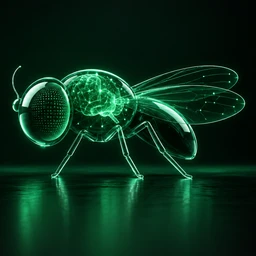
A fly brain, running on a laptop.
Scientists took the full wiring diagram of a fruit fly brain, 125,000+ neurons joined by 50 million synapses, and turned it into a simulation. Nothing was trained. Every connection came straight from the map.
Then they touched its sugar neurons. The virtual fly reached out to eat. They tested 11 of its predictions on living flies, and 10 came true.
Pick a taste below the brain █
● sensory ● firing ● inhibiting
◆ MN9 proboscis motor neuron
Run sheet · SIMFLY-01Page 1 of 1
- Subject
- D. melanogaster ♀, virtual
- Model
- Leaky integrate-and-fire, whole brain
- Stimulus
- Public buy orders, repeated
- Expected
- Proboscis extension
- Chain
- Robinhood Chain · 4663
- Launchpad
- Pons
Can wiring alone predict what a fly does?
For a century, working out a circuit meant recording neurons one at a time. The connectome made a shortcut possible: simulate the whole map and ask it.
The model treats every neuron the same way. Each one collects input, slowly leaks it away, and fires a spike when it crosses a threshold. Whether a spike excites or silences the next cell depends on the neurotransmitter the neuron makes. How strongly it pushes depends on how many synapses the two cells share.
That is the whole recipe. No behaviour was programmed in. The researchers drove a chosen group of sensory neurons with spikes and watched which motor neurons lit up at the other end of the brain.
For feeding, the one to watch is MN9, a motor neuron that moves the proboscis. If MN9 fires hard, the fly extends its mouthparts to eat.
“The connectome really does critically allow us to predict and understand how the brain works.”Philip Shiu, first author · Berkeley News, Oct 2024
What happens when you touch it.
Click a row to run it in the brain above. Counts are the ones reported in the paper.
| Input | Driven neurons | What the model shows | Recruited | Real fly |
|---|---|---|---|---|
| Sugar | Sugar-sensing taste neurons | MN9 switches on | 45 at 10 Hz · 455 at 200 Hz | Extends proboscis |
| Water | Water-sensing taste neurons | MN9 switches on, through a partly shared path | 391 · 250 shared with sugar | Extends proboscis |
| Bitter | Bitter-sensing taste neurons | Inhibitory neurons hold MN9 down | inhibitory | Keeps it in |
| Sugar + bitter | Both at once | Bitter suppresses the sugar path | sugar path damped | Barely moves |
| Antenna | Johnston's organ neurons | A small circuit: aBN1, aBN2, aDN1, aDN2 | 147 driven | Grooms antenna |
Source: Shiu et al., “A Drosophila computational brain model reveals sensorimotor processing”, Nature 634, 210–219
Eleven guesses. Ten held.
A simulation that only repeats what is known proves little. So the model was asked for something new.
The team asked the model which neurons, driven on their own at 50 Hz, would be enough to switch on MN9. It named 11 cell types.
Each of those was then switched on in living flies, one type at a time, using light to trigger the neurons. 10 of the 11 made the fly extend its proboscis. The model had been right more than 90% of the time about neurons nobody had tested before.
The whole model is this, 125,000 times.
A leaky integrate-and-fire neuron. Push current in and watch the voltage climb, leak, cross the line and fire. Slowed down 8×.
Left alone, the voltage drifts back to rest, around −52 mV. Input has to arrive faster than it leaks away.
At about −45 mV the neuron spikes and resets. The spike travels to every cell it connects to.
Excitatory transmitters push the next cell up, inhibitory ones pull it down. More shared synapses, bigger push.
From a sliced brain to a running one.
The simulation sits on top of a decade of mapping by hundreds of people and a lot of machine learning.
One brain, about 7,000 slices
The FAFB dataset: an entire adult female fly brain imaged with an electron microscope, slice by slice, at a resolution that shows single synapses.
Tracing every wire
AI segmented the images into neurons, and the FlyWire community proofread them by hand, turning pictures into a wiring diagram.
The first whole-brain run
May 2023: the leaky integrate-and-fire model appears as a preprint, built on an early release of the FlyWire map.
Map and model, side by side in Nature
2 October 2024: the adult connectome and the brain model are published together. The code is public, and a full run fits on an ordinary laptop.
What was actually run.
- Species
- Drosophila melanogaster, the common fruit fly
- Brain
- Adult female, the single FAFB specimen
- Size
- Smaller than a poppy seed
- Type
- Leaky integrate-and-fire, every neuron identical
- Wiring
- Synapse counts from the connectome
- Sign
- From each neuron's predicted neurotransmitter
- Paper
- Shiu et al., Nature 2024
- Labs
- UC Berkeley and the FlyWire Consortium, with partners
- Access
- Connectome and code are public
$SIMFLY on Robinhood Chain
$SIMFLY is a plain Pons coin. It does not run the model, fund the labs, or own any part of the fly. It marks the week a brain was copied into a computer and asked what it wanted to eat.